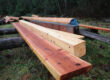
Scribing is one of the most important skills in handcrafted log building. It is also one of the least understood. People often see a finished log home and admire the smooth lines, tight joints, and natural flow of the wood. What they don’t see is the careful work that creates those details. At Cascade Handcrafted, scribing sits at the heart of every home we build. This craft transforms raw logs into a structure that feels solid, warm, and ready to last for generations.
This post breaks down what scribing really is, why it matters, and how it shapes the look and strength of a handcrafted log home—all in clear, easy‑to‑read language.
What Is Scribing?
Scribing is the process of marking one log so it fits perfectly against another. No two logs are the same. Each one has its own shape, taper, knots, and curves. Scribing allows a builder to match those shapes with precision. Think of it as tracing the exact outline of one log onto the next log below it. When the builder cuts along that line, the two logs lock together like puzzle pieces.
This is what gives handcrafted log homes their tight, natural fit. It is also what makes them strong, weather‑resistant, and beautiful.
Why Scribing Matters
A handcrafted log home is not built from milled, uniform pieces. It is built from real trees. That means every log has character. Scribing respects that character instead of forcing the wood into a shape it was never meant to have.
Here are a few reasons scribing is so important:
- Strength: A tight fit creates a solid wall that can handle heavy snow loads, wind, and time.
- Energy efficiency: When logs fit well, there are fewer gaps. This helps keep heat in during winter and cool air in during summer.
- Longevity: Good scribing reduces movement and settling issues over the years.
- Beauty: The natural lines of the logs flow together in a way that feels organic and timeless.
Scribing is not just a technique. It is a promise of quality.
How Scribing Works
The scribing process starts after the logs are peeled and sorted. Builders choose which logs will sit together based on size, shape, and grain. Then the real work begins.
A special tool called a scriber is used to transfer the shape of the lower log onto the upper log. The scriber has two points—one follows the surface of the lower log, while the other marks the upper log with a perfect mirror of that shape.
Once the line is marked, the builder cuts along it with a chainsaw and finishes the surface with hand tools. The log is then lowered into place. If the scribing was done well, the two logs fit together with almost no daylight between them.
This process is repeated for every log in the home. It takes patience, skill, and a deep understanding of wood.
The Human Touch
Scribing is one of the reasons handcrafted log homes feel so alive. Every mark, every cut, and every fit is done by a real person with years of experience. Builders learn to read the wood—its grain, its weight, its hidden twists. They learn how to adjust their cuts so the logs settle evenly over time. They learn how to work with the wood, not against it.
This human touch is what sets handcrafted homes apart from machine‑milled structures. It is also why no two Cascade Handcrafted homes are ever the same.
Scribing at Cascade Handcrafted
At Cascade Handcrafted, scribing is part of our identity. Our builders use traditional techniques passed down through generations, combined with modern tools that improve accuracy and safety. We take pride in the tight joints, smooth lines, and natural flow of every home we build.
When you see a Cascade home, you are seeing the result of hundreds of hours of careful hand‑fitting. You are seeing craftsmanship that respects the forest and honors the tree
 Drop by the Chilliwack site, request a free quote or call 1-604-703-3452 to speak directly to Markus and he will walk you through the options available to you, whether it is residential, commercial, renovations or custom floor plans, begin the journey towards your wood-based home today.